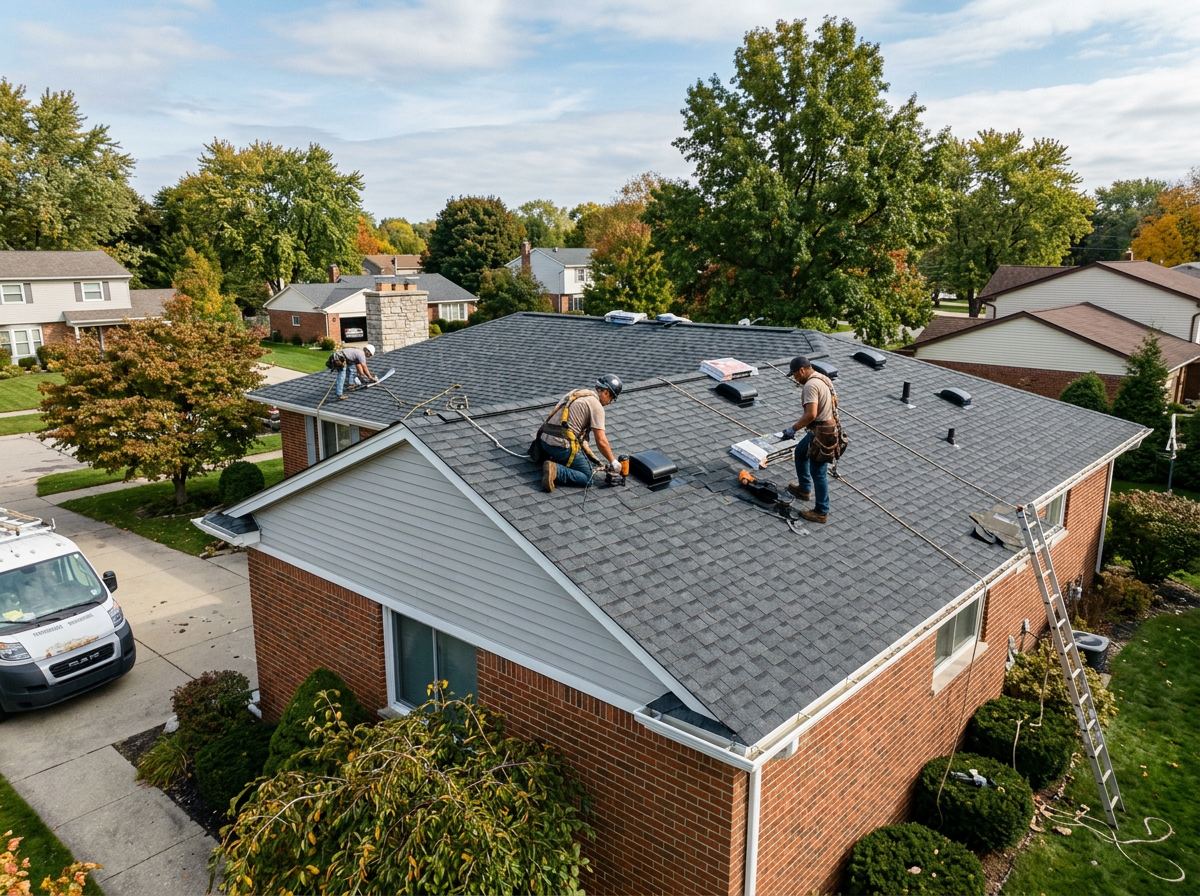
Troy homes from the 1960s through 1990s often lack adequate soffit intake and ridge vent capacity, especially on ranches and colonials near Somerset and Oakland Mall. Mature trees drop leaves and twigs that clog intake vents while freeze-thaw cycles push melting snow under shingles. Wind-driven rain and hail add pressure that forces moisture through valleys and step flashing when air cannot move freely. Without proper underlayment and ice and water shield tied into ventilation paths, granule loss and curling shingles appear faster along the Rochester Road Corridor.
We start every job with an attic inspection that checks existing ridge vent openings, soffit intake clearance, and decking condition beneath the current layer of shingles. When tear-off is required we remove old material down to the deck, install new ice and water shield at eaves and valleys, then add continuous ridge vent and matching soffit vents sized to the roof pitch. Pipe boots and drip edge are replaced at the same time so air flows from intake to exhaust without obstruction. Work is scheduled around HOA rules common in southeast Oakland County subdivisions.
After installation we verify that attic temperatures stabilize and moisture no longer accumulates during cold snaps. This approach directly reduces ice dam formation on homes exposed to the humid continental winters typical of Birmingham, Royal Oak, and Rochester areas. Proper ventilation also extends the life of architectural shingles by allowing heat and humidity to escape before they degrade underlayment or cause decking cupping.
Technician insight
In Troy, the thing that catches most people out with Roof Ventilation is how the second or third asphalt roof on 1970s ranches near Big Beaver often has the original soffit vents covered by insulation or paint, so even a new ridge vent cannot pull air. Freeze-thaw cycles then push meltwater under the shingles before anyone notices the imbalance.
Blocked Soffit On Rochester Road Colonial
Homeowner noticed ice dams forming along the front eaves after heavy snow. Inspection showed original soffit intakes packed with debris from nearby mature trees and prior insulation work. We performed a partial tear-off, cleared the intake path, added continuous ridge vent and new ice and water shield at the eaves. No further ice dams formed the following winter.
Roof Ventilation Services We Offer
✓Ridge Vent Installation
Adds continuous ridge vent along the peak to pull hot air and moisture out of the attic on Troy colonials and ranches.
✓Soffit Intake Repairs
Restores blocked or undersized soffit vents so fresh air can enter and balance the ventilation system during freeze-thaw periods.
✓Attic Ventilation Assessment
Measures existing airflow and identifies restrictions from mature trees or prior roof layers common along the Rochester Road Corridor.
✓Ice Dam Ventilation Upgrades
Combines ridge and soffit vents with ice and water shield placement to limit ice dam formation on 1970s-1980s homes near Somerset.
✓Valley and Flashing Ventilation Ties
Integrates step flashing and valley underlayment with ventilation paths so air moves freely around roof penetrations.
How it works
- 1
Attic And Roof Inspection
We examine ridge openings, soffit clearance, decking, and existing shingle condition from inside and out.
- 2
Ventilation Layout Planning
Measurements determine the correct size and placement of ridge vent and soffit intake to match roof pitch and home layout.
- 3
Tear-Off And Component Installation
Old shingles are removed, ice and water shield is applied at eaves and valleys, then new ridge vent, soffit vents, drip edge, and pipe boots are installed.
- 4
Final Airflow Verification
We confirm intake-to-exhaust balance and check that attic temperatures respond correctly before completing the job.